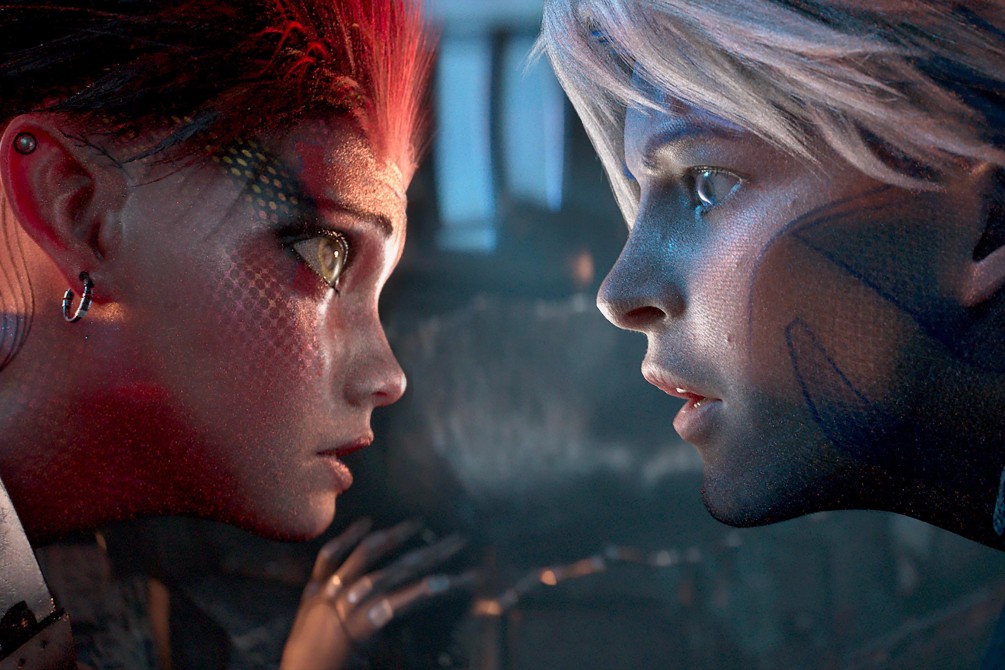
In the interest of full disclosure, the interviewer has known author and screenwriter Ernest Cline for about 10 years, when Cline and director Kyle Newman were attempting to keep control of their STAR WARS love letter FANBOYS after distributor the Weinstein Company took the film away from its creators, shot additional scenes, and caused the release date to be delayed by several years. In order to make certain he maintained control of his next creative endeavor, Cline turned to the printed word and wrote READY PLAYER ONE, a virtual-reality-set story set 30 years in the future that uses ’80s pop culture as the building blocks for a quest hero Wade Watts must go on to get control of a virtual world called the OASIS and keep it in the hands of those who would not seek to exploit it. The book was a cultural phenomenon that seemed destined to be made into a film, despite many claiming that the hundreds of recognizable brand names, familiar characters, vehicles, locations, and other references would make the story unfilmable.
Enter Steven Spielberg, the man who acted as producer and primary permission gatherer on WHO FRAMED ROGER RABBIT? (as executive producer), which would seem to make him the only filmmaker qualified to pull together a film version of READY PLAYER ONE. It didn’t hurt that Cline’s novel features dozens of references to Spielberg-directed and -produced movies. We caught up with Cline just days after the film’s world premiere at the SXSW Film Festival in his hometown of Austin, Texas, where Spielberg and the entire cast were on hand to greet the enthusiastic audience. Cline talked about the adaptation process, Spielberg pushing to make the film more like the novel, sequel plans, and his favorite 70mm movie-going experiences. It just so happens that READY PLAYER ONE will be screened on 70mm at the Music Box Theatre.
Question: In honor of READY PLAYER ONE opening at the Music Box Theatre in 70mm, I wanted to know what some of your earliest and/or favorite 70mm experiences have been over the years.
ERNEST CLINE: I'm just trying to think back of the 70mm screenings I had seen, and the list I came up with was BARAKA, which I saw at the Paramount [Theatre in Austin, Texas] and was beautiful. I saw KOYAANISQATSI, with the Philip Glass score being played live, which was amazing. LAWRENCE OF ARABIA, I think. Then THE HATEFUL EIGHT—I saw that on opening night, which was Christmas at the [Alamo Drafthouse] Ritz [in Austin as well]. DUNKIRK, of course; I saw 2001: A SPACE ODYSSEY. That may be one of my favorite 70mm experiences.
What else? Oh, IT’S A MAD MAD MAD MAD WORLD, which was one of the many crazy contests/race-for-money movies that inspired READY PLAYER ONE. There was also a film called SCAVENGER HUNT [1979], which was also an influence. There was a made-for-TV movie, which was Michael J. Fox's first movie, called MIDNIGHT MADNESS. It was also about a late-night scavenger hunt; that's not in 70mm, obviously. I’m pretty sure that I saw when I was in LA, a 70mm rep screening, maybe at the New Beverly, of ICE STATION ZEBRA, which was in Super Panavision 70. That I sought out because that was the movie Howard Hughes, when he locked himself away in that theater for a couple years, he would just watch ICE STATION ZEBRA over and over and over again. I'm like, "What is it about this, that he wanted to live inside this movie?" It was a good flick, but I still don't get it. Probably the one that I've always wanted to see in 70mm, but haven't, is BRAINSTORM.
The Music Box has played that before. It's phenomenal.
Yeah, because it's all the virtual-reality sequences are in Super Panavision 70, so that's on my list. There's something about 70mm—it’s the greater resolution and the way the images seem to pop more, but you still have that film grain that you don't get in digital projection. I grew up watching movies that weren't digitally projected, and you want a little film grain. That's one of my favorite parts in [READY PLAYER ONE]. I'm sure you’ve heard this spoiler, about the movie that we go into in the movie version of READY PLAYER ONE? Did you avoid that, or have you heard?
A particular spoiler?
Yeah, the characters in READY PLAYER ONE go into another movie, as part of the quest. In the book, they go into WAR GAMES and MONTY PYTHON AND THE HOLY GRAIL. In the movie, they go into a different movie.
I guess not. I really have gone out of my way to avoid spoilers.
Great! I'm not going to tell you. The only thing I'm going to tell you then is, we go into another movie, it's different than the movies that we go into in the book. It's one of my favorite shots in the entire movie that Steven did. When the characters cross the threshold into this virtual-reality simulation of the movie, the film grain changes from that shot into this old ’80s movie. It's my favorite thing. I feel like I've never seen that happen in a movie, where it goes to an older film grain, even though it was being digitally projected at the Paramount [where READY PLAYER ONE got its world premiere at the SXSW Film Festival]. Anyhow, so there's something about that old emulsion that I just love. I love beautiful, digital picture and perfect sound too, but there's something—maybe it's just nostalgia—about seeing movies projected on film that I love. I'm so excited to see READY PLAYER ONE in 70mm.
I was going to ask, what does that mean to you, to have your film be one of the films that is going to be available in that format from this point forward? People will keep going back to it because there will always a love of this format. Whenever any kind of 70mm festival happens, this could be among the films they play now.
I know. Steven was excited about 70mm. That's why he sent a print to Austin. That's how the Alamo got me to intro it. It opens on my birthday, and I have family in from out of town, but it was like, "Steven gave [the Alamo] this print because he wanted you to be able to introduce it in Austin, even though Austin isn't a huge market.” Well, they don't know how big of a market Austin is for film geeks.
Also, the 3-D is amazing. I've only seen certain scenes in the 3-D, but I'm going to get to see it all in 3-D tomorrow, but everybody has raved about it. Steven went and talked to James Cameron about 3-D. I know I'm biased, but it's the best use of 3-D that I've seen since AVATAR. I stopped going to 3-D movies because it distracted me, and the image ends up being darker, because they've got to project it brighter. I want to see it in every format, 70mm, 3-D, IMAX, IMAX 3-D, give it all to me! I do wonder, how much longer is [70mm] going to happen? How much longer are they going to humor filmmakers like Quentin and Steven? They don't even make the film for the cameras anymore. Doing it like this, I think it's going the way of the dodo, so I feel like I snuck in just under the wire.
Let's take a step back for a second. I remember there were a lot of directors' names that popped up in the years when you were trying to get this made. When Steven's name first surfaced, were you worried that it might almost be too on the nose, that it was too perfect a fit, if there is such a thing?
I get what you’re saying, but no, I never did. What happened was, I got depressed. They told me, "Steven Spielberg is reading it. He's interested enough to read it. He's going to read the script and then he's going to read the book too," because he always does that. That was like a two-week wait, and during that two weeks, I went from like, "Oh my God, how amazing would that be?" to the depths of depression. Three days later, I'm like, "There's no way this is going to happen, because it's too perfect." That was my reaction, "It would be too amazing." They had me make wish lists, and I’d put Christopher Nolan, Bob Zemeckis, and a bunch of people on it, but I never put Spielberg on it, because that just seemed like total hubris, "There's no way." I thought, actually, it would have been embarrassing for me to put it, because that guy decides what movies he's going to do. He doesn't need a job, he takes the jobs that he wants and that he wants to devote a couple years of his life to making the movie. That's why it just seemed impossible.
And every day that would go by, I was more certain that it wasn't going to happen, and that I was going to have to spend the whole rest of my life imagining what it would have been like if Steven Spielberg had made READY PLAYER ONE. It never entered my head that it was a possibility, and then it became a possibility, however briefly. It depressed the hell out of me, because what could be cooler than that? Now whoever ends up doing it, they might be great, but it won't be as great as Spielberg. Christopher Nolan would have been great, but not as great as Steven Spielberg. I'll take Spielberg over James Cameron or George Lucas, and I love those guys. I would take Steven Spielberg over anyone, especially because there's no READY PLAYER ONE without INDIANA JONES and THE GOONIES and E.T. and BACK TO THE FUTURE.
That was the other thing, an example that I'd always use, when people would ask me about the film adaptation and how they thought it was unfilmable. I said, "Maybe not if something like WHO FRAMED ROGER RABBIT? happened." Who was the guy who made that happen? [laughs] He went around and asked everybody, wrote letters, saying "We're doing a tribute to the whole history of cartoons and animation and we'd like to use your property." That's how they got Mickey Mouse and Bugs Bunny in one scene together. He's the only guy who can do that, because people are like, "Of course I want my IP in a Steven Spielberg movie. Of course I trust him." That was why it was even more perfect, because I was like, "If Steven did it, then everybody would say yes,” and everybody did. That was how that process went. Then when they told me, I didn't believe it, I couldn't believe it, and I still don't believe it three years later, after having gone through the whole thing.
When you started to think about him reading your book did you think, "Oh my God, he's going to read my book. This is so embarrassing, the amount of hero worship that's going on in that book. He's not going to take me seriously."
[Laughs] What embarrassed me was the dig against [INDIANA JONES AND] THE KINGDOM OF THE CRYSTAL SKULL that I put in there. Not only do I say that KINGDOM OF THE CRYSTAL SKULL doesn't count in the holy trilogy, but all future Indiana Jones movies don’t either. Remember, I'm telling this from a point 30 years in the future. Wade is talking about Halliday's opinion of INDIANA JONES, BACK TO THE FUTURE, those are holy trilogies, but KINGDOM OF THE CRYSTAL SKULL onward doesn't count. That was one of the first things that I thought, "Oh my God, he's going to read that. That's going to put it in the trash, and be like, 'Fuck this guy,'" but he didn't. Maybe that little tiny dig—which was a dig by the character, not me technically—balanced out the hero worship. I will tell you I was on the set and David Koepp [who wrote CRYSTAL SKULL and is writing a new INDIANA JONES screenplay] came to visit him to talk about the next Indiana Jones movie. I could have gone over to introduce myself, but I didn't. I'm like, "Those guys know I'm me, a lunatic interrupting them.” It's just the worst thing I could have thrown in there. Who knows, if I hadn't put that in there, maybe he would have been like, "This is too much hero worship," so maybe that balanced it out.
Give Spielberg specifics about what he responded to, either in the book or your drafts?
Yeah. Steven showed a friend of mine a video of him finishing reading the book. He's out in his garden playing with his grandkids, and he's like, "I could be over there playing with my grandkids, but I can't put this book down." It’s a five-minute video, and then he finishes the book, and he's like, "I have to do this movie." And he told a story at the Paramount about the two things that made him decide, which were his wife, who listened to the audiobook and said, "There's no more discussion. You have to do this movie." The book made her cry, which Will Wheaton read. He said there's a chat log sequence, a chapter that just opens with Art3mis and Wade talking back and forth, in an internet chatroom. He said there was something about that and how that really captured the innocence of their relationship, he said “If I can capture that in the movie, then I’ll really have something.” That whole chat log sequence, which a lot of people hate, that was the part that Steven told the audience at the Paramount he responded to and made him decide to do it.
From what I read about his introduction to the movie at SXSW, he made it clear that he made this film always thinking about the audience’s reaction, “This is a movie, not a film.” Could you see that? That’s different than what he's done in a while.
He told me that from the outset. After I saw it for the first time, we had this great conversation where I told him how much it meant to me and how I felt it captured the spirit of my book perfectly. Even though a lot of stuff is different, the spirit of the book and the spirit of the characters is all there, and it's beautiful. He said, "Thank you. Almost since JURASSIC PARK, I've been wanting to make another ’80s movie." He called it an ’80s movie, even though JURASSIC PARK wasn't made in the ’80s. It’s like a movie with a a ragtag group of kids that band together to save their reality, which is just like THE GOONIES, which was based on a story that he based on his own childhood growing up in Arizona.
He said that he missed making movies like that, and he hadn't made a movie like that in a long time, and when READY PLAYER ONE fell in his lap, he said he felt like, "Ah, this is my chance to make another blockbuster, to make a movie like I used to make, which I haven't done in a long time." I think he was like me: "Can I still do that?”, whereas I'm like, “Can I do it at all, this is my first novel? Can I tell this kind of story and have it be a success?” He had nothing else to prove. He still makes movies because it's invigorating to him, and he loves collaborating with actors and artists. It keeps him healthy and keeps him vibrant and alive. He said, he's worked harder on this than any other of his movies, except for JAWS and SAVING PRIVATE RYAN. JAWS will always be the worst experience, and in SAVING PRIVATE RYAN, they were recreated D-Day, day by day. He was younger then, but he said he lost more sleep and invested more time and energy. This was a Herculean thing, because it was like making two different movies. It was making a CGI movie, intercut with a live-action movie.
Plus, he also made another movie [THE POST] while this one was being finished. Not that anything got paused, but that had to be weird for you.
It was weird, but it just pretty much cemented what a badass her is, and he made it for political reasons. "This is the right story to tell at this time, and I'm going to do it." The only thing that pissed me off about it is, I'm pretty sure that he did it because of Trump's relationship with the press, and that resulted in John Williams doing the score for THE POST, instead of doing the score for READY PLAYER ONE. I genuinely believe that that Alan Silverstri score is perfect, but that's another way that Trump screwed me over [laughs]. Who knows what the ripple effects are? I love Alan Silvestri's score, which I've been listening to on a loop since I got it. But I'm always going to imagine what the John Williams score would have been like, but I will count my blessings.
Still, Alan Silvestri, you can look back on and go, "Hey, I got the guy that did this, this, and this."
He’s the guy who did BACK TO THE FUTURE. I listened to his score for CONTACT while I was writing READY PLAYER ONE, I told him this. I'm like, "I was listening to your music," because I can't listen to stuff with lyrics; I always listen to film scores. I was listening to PREDATOR, and the list goes on.
He did ROGER RABBIT, which seems thematically appropriate.
Yeah, yeah. Almost all of Zemeckis's movies. I got to go to the scoring session and sit there with Steven while he was conducting and hear him reference other scores, like DeLorean Reveal. It's the best ever. It's all downhill for me.
I was going to save this question until the end, but since you said that: What is it like to have your dreams come true?
It's wonderful!
Wonderful and horrifying? You're still relatively young.
The scariest thing is making ever other movie nerd in the world jealous. A lot of them aren’t good at hiding their jealousy. I wouldn't be either: "Fuck that guy." My wife says, "That's not true, you were never that way." I used to gain inspiration from those guys. I would look at Robert Rodriguez or Kevin Smith, especially, and be like, "Man, this guy started out as just a fan. By celebrating what he loved and going after what he loved, he managed to end up getting work with all the people who helped inspire him." That was always my goal.
But you see somebody else do it, and it's hard to believe that anybody else other than Kevin would be able to pull that off. By taking inspiration from him and Rick Linklater and Robert and Steven Soderbergh, and people like that, somehow I managed to get there too, which just feels wonderful. But I do think "What could top this?" The answer is, nothing. If George Lucas came out of retirement and directed my second novel, that would be pretty awesome, but it's not going to happen. Or James Cameron, if I got to make a movie with him, but James Cameron's slate is full for quite some time. Those are the only two guys that come close in my mind, of people who made me want to be a director or made me want to be a screenwriter and make movies. Steven wa always at the top of the list, and at the top of everybody's list, anybody with any sense or taste.
I wanted to ask about the adaptation process. I know that you wrote a draft, and Zak Penn is credited as the co-screenwriter, and there was somebody else in between. Did you have to let go a little bit? Was that an easy thing for you? What was it like handing it over to somebody else after living with it for so many years?
What was weird for me about the process was, I sold the book in June of 2010, and then sold the film rights the very next day, because the bidding war over the book rights alerted the movie studios. The very next day, there was a bidding war for the film rights that Warner Bros. won, with me attached to write the screenplay. They wanted me to start right away, and the book was already finished. I wrote three drafts of the adaptation for READY PLAYER ONE, all before the novel was actually published. When I was writing it, I couldn't point to it being a bestseller yet, much less an international bestseller in hardcover and paperback in a bunch of other countries. None of that, I didn't have any of that leverage. It was my first time working for a big movie studio.
My only other experience had been FANBOYS, which was a nightmare in every way and continues to be a nightmare. That's the worst experience I will hopefully ever have. That's my JAWS, as a writer. With this, they made me move as far away from the book as I would, "Maybe tone down the ’80s references”—all of that happened. Then they hired another writer, Eric Eason, a wonderful guy, who took it even further away from the book, and they named that draft THE OASIS, instead of READY PLAYER ONE. By that point, I was just like, "Wow, this is not going to end up resembling my story at all." Then the book, as it grew in popularity and success, they decided, "Maybe we should bring it back closer to the book," but that was after it was published.
And Zak was the one they tasked with doing that, and what's crazy is, I had just met Zak, because he invited me to come down and be a part of this documentary that he was making about digging up the E.T. cartridges in the desert [ATARI: GAME OVER]. He directed that. We met and became fast friends. I was a fan of LAST ACTION HERO and PCU, and X-2 was amazing, one of my favorite superhero movies. He and I hit it off, and I helped him with that documentary. Then, once he started working on READY PLAYER ONE, he just called me like you would a friend and said, "Hey, what about this?" He consulted me all through writing his draft. Then, it got even better when Steven came on board, because Zak called me after the first meeting with him, and said, "Ernie, it's a good thing you weren't there. Steven Spielberg came in and read aloud from your book for like an hour. He came in, he had like 50 Post-It notes, and he said, 'Why isn't this in the movie? This needs to be back in the movie.'" They just said yes to everything.
Zak told me, and I've seen pictures of this, that Steven would just take pictures of paragraphs in the book—hold up the book, take a picture with his phone—and send it as an email attachment saying, "Just do this." Over and over again. There are whole PDFs that got passed around with producers, that are full of snapshots of the book that Steven Spielberg took. He brought it even further back to the book, and also included me in everything. I got to help with the whole going into a new movie sequence that I don't want to spoil for you. All the reworking of the stuff that's in the final movie, I got to be a part of. It was just the best experience you could ever have, man. Everything you could ever want to happen.
Such a different experience than FANBOYS…
I know. You know what happened, they tried to take the movie away from [director] Kyle Newman, they changed the ending, everything—it was the exact opposite. I've had two movies: my tribute to George Lucas that was disaster, and my tribute to Steven Spielberg, which was exactly what you could want. Like I said, all downhill from here [laughs].
You said you were on set, what was it like having these images from your brain suddenly in front of you. That was probably different than you experience on FANBOYS as well.
FANBOYS, that was crazy, because those characters were based on me and friends I grew up with, and that was a great experience being on the set, because that was before the nightmare of post-production began. I was an extra in the scene with Captain Kirk in FANBOYS, so that was all pretty great. I was like, “FANBOYS is my one chance to make a movie." There were cool moments, but it's probably never going to happen again. The FANBOYS, they're from Ohio, and they leave a town that's named after my hometown, so I had that experience once, which was amazing and really inspiring.
FANBOYS was also what made me become a novelist. I don't want to be a screenwriter. You have no control at all over your characters. Everything that they can and do to ruin it will happen and did happen. I said, "Let me just try writing a novel, and then there will be nothing between me and the audience. I can just geek out and drill down into the geeky details as much as I want, just to see if I can do it, just to see what'll happen." Then once I started seeing [production designer] Adam Stockhausen's stuff—when I first met Steven, he started showing me pre-vis that he'd already had done and animatics that were put together of the race. I was already getting excited. Then I went and visited the set three different times for like three weeks, and that was like walking onto the paperback cover of my book, into the Stacks, which they had built for real and engineered; there are extras climbing all over them and populating the different trailers. It was 360 degrees, everywhere you looked, I was surrounded by this world I had built.
And so much stuff from the book that had never made it into the script still made it in the movie, because there were copies of the book everywhere. In the costume department, props, and vehicles, Steven had it be a reference text. I can remember seeing Aech the first time, played by Lena Waithe, and she's wearing the exact same Rush 2112 t-shirt that she's wearing in the book, and that never made it into any of the scripts, but somebody in the costume department put her in the same exact costume that she's in in the book. Stuff like that is everything that you could want.
As much as some people have called the book this sort of nostalgia orgy and a testament to people who live on their devices, what I remember from reading it the first time was that there was definitely a message about finding a balance between your online life and real-world connection. There was a cautionary message in there about that.
There is, and it's maintained and conveyed by Halliday, played by Mark Rylance, in the exact same words that are used in the book. He's like, "Reality is where you can only find true happiness, because reality is real." Halliday says that in the book and he says it in the movie. The way the book ends, suddenly for the first time in his life, Wade doesn't immediately want to log back into the OASIS. It’s not like he never wants to use the OASIS again, but today he's happy to be in the real world. That's the same sentiment.
It's not about going cold turkey or not embracing technology or using it, because it's the most powerful communication tool that we've ever created. It allows everybody all around the world to communicate and collaborate with each other, regardless of their borders or geographic location. It's amazing and it's a good thing, but like anything, you can do it to excess. I feel like it's like striking a balance between fantasy and reality, both of which are essential. You have to attend to the needs of the real world, but fantasy, art and escapism are essential parts of our lives, and the reason that most of us—guys like you and me—that we stay alive. That's what we look forward to—more art and more entertainment from the artists and creative people we love.
More than anything, that's what READY PLAYER ONE is about for me, celebrating all of that and also celebrating the internet and the way the internet connects you with other people who love the stuff that you love. Now, it connects you with the people who hate the stuff that you love [laughs], but for a brief time there, back around 2010, it seemed like, "Wow, the internet has fulfilled its promise. If you love Harry Potter or Dr. Who or whatever you love, you go out on the internet and find other people who love it." You can still do that, but you have to wade through all the people who hate everything. That was what I was trying to celebrate, and I think it comes across in the movie. That's what I love so much about seeing it with that audience at the Paramount. Having Steven Spielberg there just cut through it all the negativity.
Are you excited to watch the inevitable, multitude of YouTube videos of people dissecting the film, looking for references and Easter eggs?
I was watching them for the trailers; they're so much fun. Yeah, anything that brings people joy; that's where I stand. If you derive joy from it, that's a rare commodity in this world. If you're going to dis something that brings someone else joy or brings clearly millions of people joy, then what kind of person are you? Are you making the world a better place or a more negative place? It's real easy to come down on which side you're on. There's a line in the movie that reviewers I've seen complain about it, when Wade says unironically, “A fanboy knows a hater." People are like, "Oh, it's such a cringy line, or such a groaning line." I'm like, "Guess what? He's talking about you." If that line bothers you, there's a reason.
Steven Spielberg is that way too. That's one of the things that made him want to make a movie like this, because the ’80s had a refreshing lack of cynicism. Now, cynicism rules the day. Some people will read the book and will watch the movie and be like, "This is not cynical enough. This is too cheesy,” but “cheesy” is another word for enthusiastic. It's such a pure, fun movie, with people who love things and celebrating the things that they love, and the connection that that brings you, which is what FANBOYS was about too, before it got butchered—loving STAR WARS and growing up loving STAR WARS, and the way that could bond you together with your friends and connect you the way that any positive element of culture does. People can hate on pop culture, but it's our culture and always has been. It's what bonds a lot of us together and helps us form connections with other people. The book and the movie both are about that.
One of the most thrilling things for parents is having your kids love the things that you loved at their age. It doesn't happen that often…
I've been told that so many times at book signings, "My kids never used to care about the ’80s or my childhood, and now they're asking me all these questions because of your book.”
That has to be one of the most rewarding aspects of this whole experience, that you're bringing together these families in a way that they maybe wouldn't have otherwise.
Yeah, dude, it's so gratifying. It makes me so happy. That's the thing, when you go out into the world, and I meet people out in the world, there's nothing but love and gratitude from people. I've heard Kevin Smith say this too, he gets so much hate online, but when he goes out into the world, real people come up to him, "I love what you do. It brings me so much joy." It's such a weird time to be an artist or a creative person of any kind in the age of the internet, because you get an instant avalanche of feedback. You have to filter out all of it in order to go forward and be a creative person. Some people are going to dig it; some people aren't. I'm doing it for myself and for the people who are going to dig it. It's hard, even for film critics. It's the hardest time ever to be especially an enthusiastic film critic. Everybody wants a hot take. They don't want to hear how great something is. They want to hear how awful it is and what a disaster it was. "Oh you love it, that's nice, but I don't love anything. Nothing brings me joy. Who are you to shove joy down my throat?"
Last thing I want to ask you, I had heard that you're doing a sequel. Is that a sequel to the book or to the movie or both?
Both. I'm in that Michael Crichton position, where they're going to make THE LOST WORLD whether I write it or not, so I'm going to go ahead and write it, so I can maintain control of my story. Same thing with Thomas Harris. They were going to make HANNIBAL RISING whether or not Thomas Harris wrote it. If he wanted to write his own character's origin story, he had to do it. I knew I was going to be in that position, that I would want to write the sequel to the book before I saw the movie, so I had more or less a rough draft before I saw the movie for the first time.
The book [READY PLAYER ONE] takes place over almost a year of time, whereas the movie is like three or four days. It's a much more condensed version of the story, with a lot of the darker elements excised. I definitely sat down and crafted a story that I knew there could be a sequel to and serve as the basis for a movie sequel, but would be a direct sequel to the book, and pick up all the story threads, and follow the chain of events that occurred in the book, because that's what people who read the book sequel are going to want. It'll also tell you what happens with the characters and hopefully serve as a basis for the movie sequel, if they make one. Who knows if they will? My book will exist and be published first.
I think that they've made me such a central part of READY PLAYER ONE and recognized my contribution, and Steven obviously has, that I don't think that they would try to make … It's different, that's what's great about being a novelist, dude, as opposed to a screenwriter, nobody cares if LETHAL WEAPON II was written by Jeffrey Boam instead of Shane Black; it’s more LETHAL WEAPON, but we knew it wasn't Shane Black. For the people who love books, it gives you so much more leverage if you can release your version of the story before the movie version.
Do you have a target release date on that?
They haven't decided yet. I think they might want to save this Christmas for selling more copies of READY PLAYER ONE, after the blu-ray comes out, so maybe next year? I don't know yet, but definitely before there's any movie, there will be a book.
Ernie, I couldn’t be happier for you. Continued success.
Thank you, dude. I appreciate your kind words and your support. Let's catch up after you see it.
Steve Prokopy is the chief film critic for the Chicago-based arts outlet Third Coast Review (www.ThirdCoastReview.com). For nearly 20 years, he was the Chicago Editor for Ain’t It Cool News, where he contributed film reviews and filmmaker & actor interviews under the name “Capone.”
CLICK HERE for Showtimes & Advance Tickets to READY PLAYER ONE in 70MM