
About

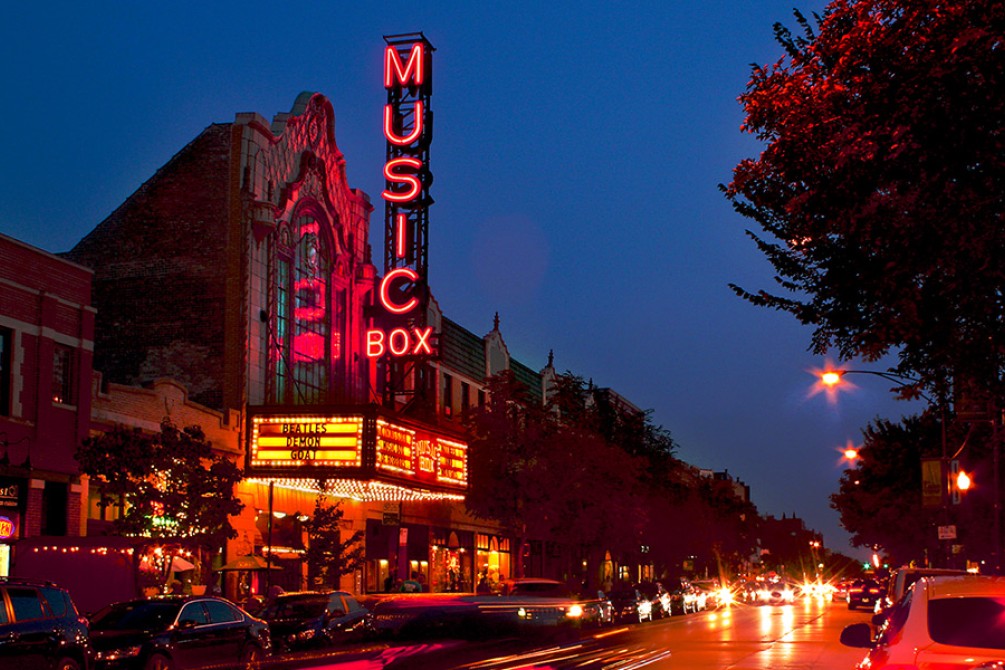
For the last two decades, the Music Box Theatre has been the premiere venue in Chicago for independent and foreign films. It currently has the largest theater space operated full time in the city. The Music Box Theatre is independently owned and operated by the Southport Music Box Corporation. SMBC, through its Music Box Films division, also distributes foreign and independent films in the theatrical, DVD and television markets throughout the United States.

Contact Us

E-mail

Phone

  • Showtimes: 773-871-6604
  • Office: 773-871-6607
  • Fax: 773-871-0602

Mail

Music Box Theatre
3733 N. Southport Ave.
Chicago, IL 60613

Ticket Information

  • General Admission: $9.25
  • First Show of the Day Discount (Monday-Thursday only): $8.25
  • Monday Special: $5 Admission and buy one, get one popcorn and soda! NEW

With the exception of some special presentations, tickets are not sold in advance.
The box office accepts cash, Visa and MasterCard.

Save Money with the Music Box Discount Card

Five admissions for only $33.00
Save up to $2.65 per admission!
May be used for 1 or 2 admissions per show
Valid for 6 months from the date of purchase
Available at the box office or by mail

To purchase your Discount Card by mail, send $33 plus $1 shipping & handling to:
Discount Card
c/o Music Box Theatre
3733 N. Southport Ave.
Chicago, IL 60613

Parking Information

Parking near the Music Box is limited. Please allow extra time when arriving be car, and consider using public transportation. Southport is a metered parking street. The meters run from 9:00am until 9:00pm Monday through Saturday and 10:00am through 8:00pm on Sunday. All neighboring streets are available for parking before 6:00pm (after 6:00pm some streets are permit–parking only. Please read signs carefully). Free street parking is available on and west of Ashland Ave (two blocks West of the theatre) and north of Irving Park.

Blaine Parking Lot: Parking is available at Blaine Elementary located at 1420 W Grace St, Chicago, IL‎ , or just North of the theatre on Southport. The lot there costs $10 and takes exact change or credit cards.

Valet Parking: The Music Box has a valet relationship with Black and White Valet Services. Thursday through Saturday nights and for special events, a Valet Service will be provided for $10 to $15 at the Blue Bayou restaurant (located across the street from the Music Box)

Both the lot and the valet close at 2am.

Theatre Location

Driving Directions

From Lake Shore Drive

Exit onto Irving Park Road, drive one mile west, turn left onto Southport Avenue. We are two block south of Irving Park Road.

From I-90/94

Exit onto Irving Park Road drive east approximately three miles, turn right onto Southport Avenue. We are two block south of Irving Park Road

For a detailed map and driving directions, visit Google.

CTA Train

Red Line

Exit at the Addison stop, walk five blocks west to Southport, turn right onto Southport Avenue, walk two blocks north.

Brown Line

Exit at the Southport stop, walk three blocks north.

CTA Bus

Clark

Exit at the Grace stop, walk three blocks west to Southport, turn left onto Southport Avenue, walk a half block south.

Ashland

Exit at the Grace stop, walk three blocks east to Southport, turn right onto Southport Avenue, walk a half block north.

Irving Park

Exit at the Southport stop, walk two blocks south.

Addison

Exit at the Southport stop, walk one block north.

For detailed CTA directions, visit the Chicago Transit Authority.

Theatre History

The Music Box Theatre opened on August 22, 1929, a time when the movie palaces in downtown Chicago each had seating capacities of around 3,000 people. The Music Box, which sat 800, was considered an elaborate little brother to those theatres. Theatre Architecture magazine noted in 1929 that the theatre “represents the smaller, though charming and well equipped, sound picture theatre which is rapidly taking the place of the ‘deluxe’ palace.”

The Building

The theatre was built for a cost of $110,000. The entire building, which also included nine storefronts and 32 apartments, cost $260,000. The building was designed by Louis A. Simon, a local architect who was better known for his Depression-era WPA Post Offices and homes for the nouveau riche. The building was erected by The Southport Avenue Businessmen’s Association and operated by Lasker and Sons, who operated several smaller neighborhood houses in Chicago.

Innovation

The design of the Music Box was indicative of the growth of the motion picture. The grand movie palaces that preceded it were multiple use facilities with stage and film presentation capabilities. The Music Box had no stage and, therefore, could only be a film presentation house. When the theatre was built, sound films were a new technology, and the plans included both an orchestra pit and organ chambers if sound films failed and silent film accompaniment was needed.

Architectural Style

As Chicago Tribune architectural critic Paul Gapp wrote (Arts and Books, July 31, 1983), The architectural style is an eclectic melange of Italian, Spanish and Pardon-My-Fantasy put together with passion. The actual style is called “atmospheric”. The dark blue, cove-lit ceiling with “twinkling stars” and moving cloud formations suggests a night sky. The plaster ornamentation of the side walls, round towers, faux-marble loggia and ogee-arched organ chambers are, by Hollywood standards, reminiscent of the walls surrounding an Italian courtyard. Overall the effect is to make the patron feel that they are watching a film in an open air palazzo.

Restoration and Rebirth

Between 1977 and 1983, the Music Box was used sporadically for Spanish language films, porno films and lastly, Arabic language films. In 1983, management reopened the theater with a format of double feature revival and repertory films. Eventually, foreign films were reinstated, and independent and cult films were added to the roster. The Music Box Theatre now presents a yearly average of 300 films.

In 1991, management decided to add a second screen. Rather than split the main theater in two, a small theater was built in an existing storefront adjacent to the lobby. The ambiance of the theatre was designed to echo the architecture of the main auditorium. The feeling is still atmospheric but because of the 13-foot ceiling, the feel is that of sitting under a garden trellis with stars in the night sky beyond.

The Theatre Ghost

Old theaters have ghosts and The Music Box is no exception. “Whitey”, as was his neighborhood nick-name, was the manager of The Music Box from opening night 1929 to November 24, 1977. His wife was the cashier and they raised their family two blocks away from the theater. According to one of Whitey’s daughters and his daughter-in-law, he spent most of his time at the theater. Young people who grew up in the neighborhood tell tales of working for Whitey, being tossed out by Whitey and accidentally-on-purpose skinning their knee to get a free piece of candy from Whitey. Parents speak of the embarrassment of having their child’s instamatic photo in the cashier’s station “rogues gallery” of children not allowed back in the theater for any of a myriad of offenses. On Thanksgiving eve, 1977, Whitey returned to close the theater. He fell asleep on the couch in the lobby and never woke up.

Whitey is a tireless protector of The Music Box Theatre. He helps solve problems and has been known to express his opinion of a bad organist by causing the drapery to drop in both organ chambers simultaneously. He is a positive contributor to the audience’s comfort and enjoyment of his theater. He is sometimes felt to be pacing Aisle 4 (protecting the alley doors where kids used to sneak in). If you see him, be sure to say hello and thank him for his 48 years of care and operation of The Music Box and his continued service to the patrons. He is the Manager Emeritus.

Current Operations

For the last two decades, the Music Box Theatre has been the premiere venue in Chicago for independent and foreign films. It currently has the largest theater space operated full time in the city. The Music Box Theatre is independently owned and operated by the Southport Music Box Corporation. SMBC, through its Music Box Films division, also distributes foreign and independent films in the theatrical, DVD and television markets throughout the United States.

Theatre Photos

Big Fan

Big Fan

Where the Wild Things Are premiere

Where the Wild Things Are premiere

John Turturro

John Turturro and the Chicago premiere of Romance & Cigarettes

Harry Belafonte at Noir City: Chicago

Harry Belafonte at Noir City: Chicago (photo credit Stephen Leung)

Harold Ramis

Harold Ramis and the Music Box staff

David Lynch

David Lynch presents Inland Empire

Vince Vaughn

Vince Vaughn at the premiere of The Break-Up

Jennifer Aniston

Jennifer Aniston at the premiere of The Break-Up

Web Site

The Music Box Theatre and Music Box Films web sites were designed in-house by Chris Welch, who in 2009 approached Adam Khan at Engaging.net to power them with the ExpressionEngine publishing system. Adam and Program Director Brian Andreotti collaborated on defining and deploying the system’s functionality. The sites’ contents are now maintained by General Manager Dave Jennings and Austin Vitt.